


Stemcell Science Shop
SEG Geophysical Monograph Nos. 1 & 2 — Original 1971–1973 Set
SEG Geophysical Monograph Nos. 1 & 2 — Original 1971–1973 Set
No se pudo cargar la disponibilidad de retiro
A matching pair of the first two volumes in the Society of Exploration Geophysicists' Geophysical Monograph Series, published in 1971 and 1973. Together, these books provide a fascinating snapshot of exploration geophysics during a period when increasingly sophisticated instruments and computer processing were transforming scientists' ability to investigate the Earth without directly excavating it.
No. 1 — Elementary Gravity and Magnetics for Geologists and Seismologists
L. L. Nettleton — 1971
The inaugural volume of the SEG series was written by influential American geophysicist Lewis L. Nettleton (1904–1996), an important figure in the development and practical application of gravity surveying.
Gravity and magnetic surveys reveal otherwise invisible geological structures by measuring minute variations in Earth's gravitational and magnetic fields. Differences in rock density and magnetic properties can indicate buried faults, sedimentary basins, igneous bodies and other subsurface structures.
Nettleton's work helped establish gravity surveying as an important exploration technique, particularly in petroleum geology. His name remains associated with the Nettleton method, used to estimate rock density for terrain and Bouguer gravity corrections.
The book covers rock density, gravity instrumentation, field measurements and corrections, gravity anomalies, interpretation, magnetic exploration and period technologies including torsion instruments and shipborne and underwater gravity meters.
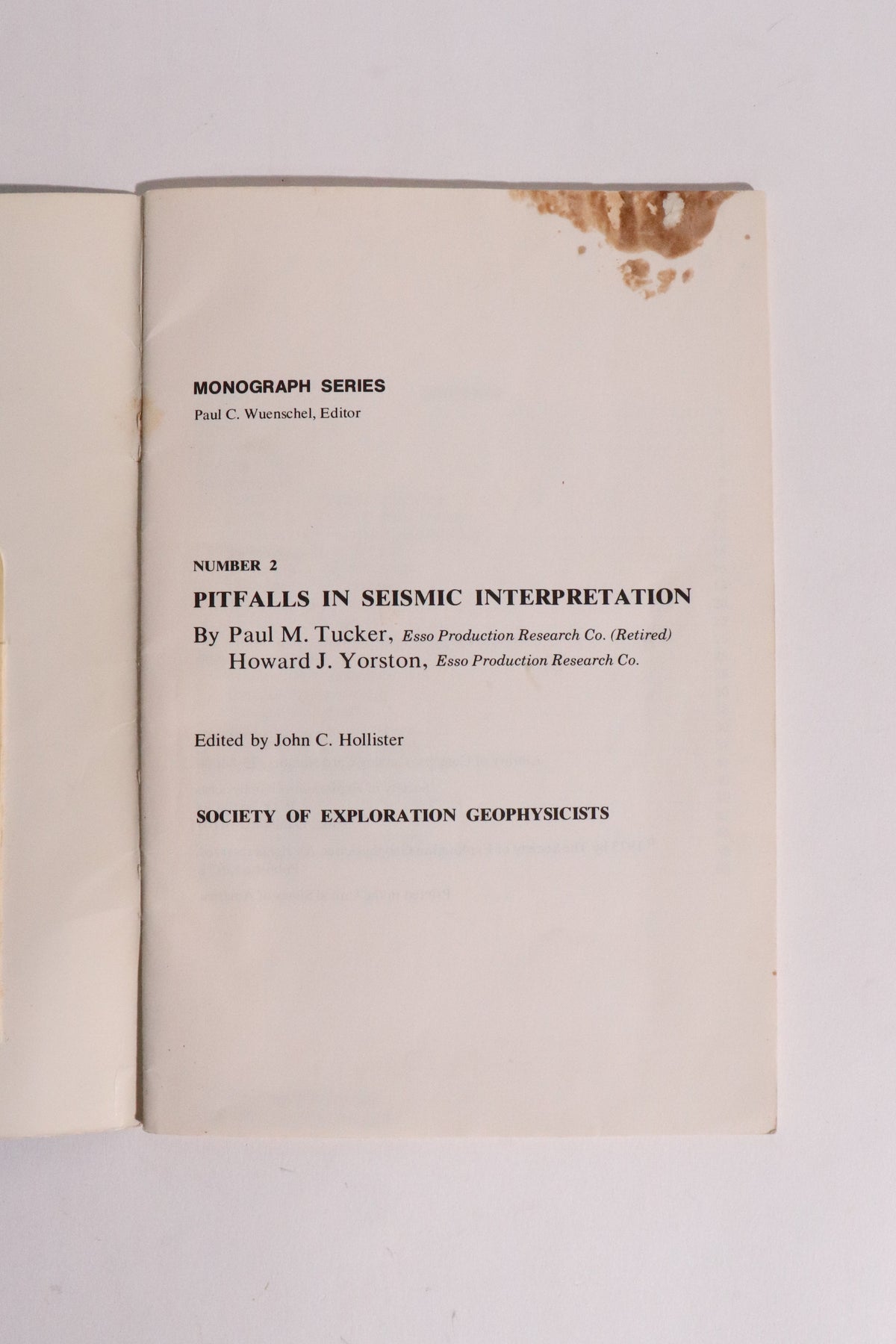
No. 2 — Pitfalls in Seismic Interpretation
Paul M. Tucker & Howard J. Yorston — 1973
Published two years later, the second SEG monograph addresses a very different problem: how convincing seismic data can fool the scientist interpreting it.
Tucker and Yorston organized the book around numerous real-world examples of misleading seismic structures. Changes in seismic velocity, subsurface geometry, data acquisition and processing can create apparent geological features that do not actually exist—or disguise structures that do.
The book appeared at an especially interesting moment in the history of geophysics. Computer processing was rapidly improving the sophistication of seismic exploration, but the resulting images could contain increasingly subtle processing artifacts. Pitfalls in Seismic Interpretation taught geophysicists to recognize these deceptive effects rather than treating a processed seismic section as a literal picture of underground geology.
Together, these volumes represent Geophysical Monographs No. 1 and No. 2, the beginning of a professional series published by the Society of Exploration Geophysicists (SEG) in Tulsa, Oklahoma.
Their matching period covers incorporate actual-style geophysical traces into a distinctive 1970s graphic design, with No. 1 printed in yellow and No. 2 in blue. As a consecutive pair, they provide an appealing physical artifact from the history of petroleum exploration, seismology and applied Earth science.
Included:
No. 1: Elementary Gravity and Magnetics for Geologists and Seismologists — L. L. Nettleton, 1971
No. 2: Pitfalls in Seismic Interpretation — Paul M. Tucker & Howard J. Yorston, 1973
Publisher: Society of Exploration Geophysicists, Tulsa, Oklahoma
Series: Geophysical Monograph Series, Nos. 1 & 2
Subject: Geophysics / Seismology / Gravity / Geomagnetism / Petroleum Exploration
Condition: Vintage ex-library copies with library labels and institutional markings. Covers show rubbing, scratches, edge wear and other signs consistent with age and institutional use. Interiors remain intact with expected library evidence and age-related wear. Please refer to photographs for exact condition.
An uncommon opportunity to acquire the first two SEG Geophysical Monographs together as a matching original 1971–1973 set, particularly suited to collectors of geology, seismology, petroleum history, scientific instrumentation and vintage technical publications.
Shipping
Shipping
USA DOMESTIC SHIPPING
We offer standard shipping (5–9 business days) on all U.S. orders.
CANADIAN SHIPPING
Orders within Canada typically arrive within 3–7 business days. Please note that depending on the product or supplier, customs or duties may apply.
INTERNATIONAL SHIPPING
We offer standard international shipping (2–6 weeks). Import duties, taxes, and charges are not included in the item price or shipping cost. These charges are the buyer's responsibility and may vary by country.
Hassle-Free Returns
Hassle-Free Returns
We hope you love what you ordered! If something isn’t quite right, whether it’s the size, color, or simply not what you expected, feel free to reach out.
Returns and exchanges are handled according to our policy, which may vary depending on the product. You can review all the details here.
If you have any concerns or would like to discuss an exchange, don’t hesitate to contact us, we’re happy to help.
Our goal is complete customer satisfaction.



Shop with Purpose
OSADIA is a Spanish word that means "audacity." We believe this word reflects the unique journey and stories behind our products, those stories are all about hard work, courage and resilience. In Osadía you will find unique fair trade, handmade & socially responsible products, every product is empowering artisans, small businesses and vulnerable communities around the world.