


Stemcell Science Shop
Structured Techniques for Computing — James Martin & Carma McClure | Early Software Engineering & CASE, First Printing (1985)
Structured Techniques for Computing — James Martin & Carma McClure | Early Software Engineering & CASE, First Printing (1985)
Couldn't load pickup availability
A first-printing copy of James Martin and Carma McClure’s Structured Techniques for Computing, a substantial 1985 reference documenting the methods used to bring greater rigor, consistency, and visual structure to software development during the transition from ad hoc programming toward modern software engineering.
At nearly 800 pages, the book surveys an unusually broad range of techniques for analyzing, designing, documenting, and building computer systems. Subjects include structured programming, modular design, top-down development, data-flow diagrams, entity-relationship modeling, pseudocode, data dictionaries, functional decomposition, structured analysis, database design, program testing, and software documentation. Google Books catalogs the Prentice-Hall edition at 775 pages and identifies it with software engineering and structured programming.
The book is particularly interesting as a historical record of the period when computing organizations were trying to turn programming from an individual craft into a more systematic engineering discipline. Its diagrams and methodologies were intended to make complex information systems understandable before code was written, allowing analysts, programmers, managers, and increasingly end users to work from shared models of a system.
One photographed section shows entity-relationship diagrams, including entities, attributes, links, unique identifiers, and cardinality—concepts that remain fundamental to database modeling today. Elsewhere the book covers data-flow diagrams, structure charts, HIPO diagrams, Warnier-Orr diagrams, Jackson diagrams, structured English, pseudocode, and other once-prominent techniques for making software design explicit and reviewable.
Its historical significance becomes even clearer in retrospect. In 1988, Martin and McClure revised this work under the title Structured Techniques: The Basis for CASE, explicitly connecting its methods to the emerging field of Computer-Aided Software Engineering (CASE)—software tools intended to automate parts of systems analysis, design, documentation, and eventually code generation. Library records for that later edition specifically note that it was previously published as Structured Techniques for Computing.
That places this 1985 edition at an interesting point just before CASE became one of the major enterprise-computing movements of the late 1980s. Much of the terminology has changed, but the underlying concerns—managing software complexity, modeling data, separating requirements from implementation, reducing errors, and designing systems before coding them—remain central to software engineering.
Authors: James Martin and Carma L. McClure
Publisher: Prentice-Hall, Inc., Englewood Cliffs, New Jersey
Year: 1985
Edition: First Prentice-Hall Edition
Printing: First Printing
Series: The James Martin Books on Computer Systems and Telecommunications
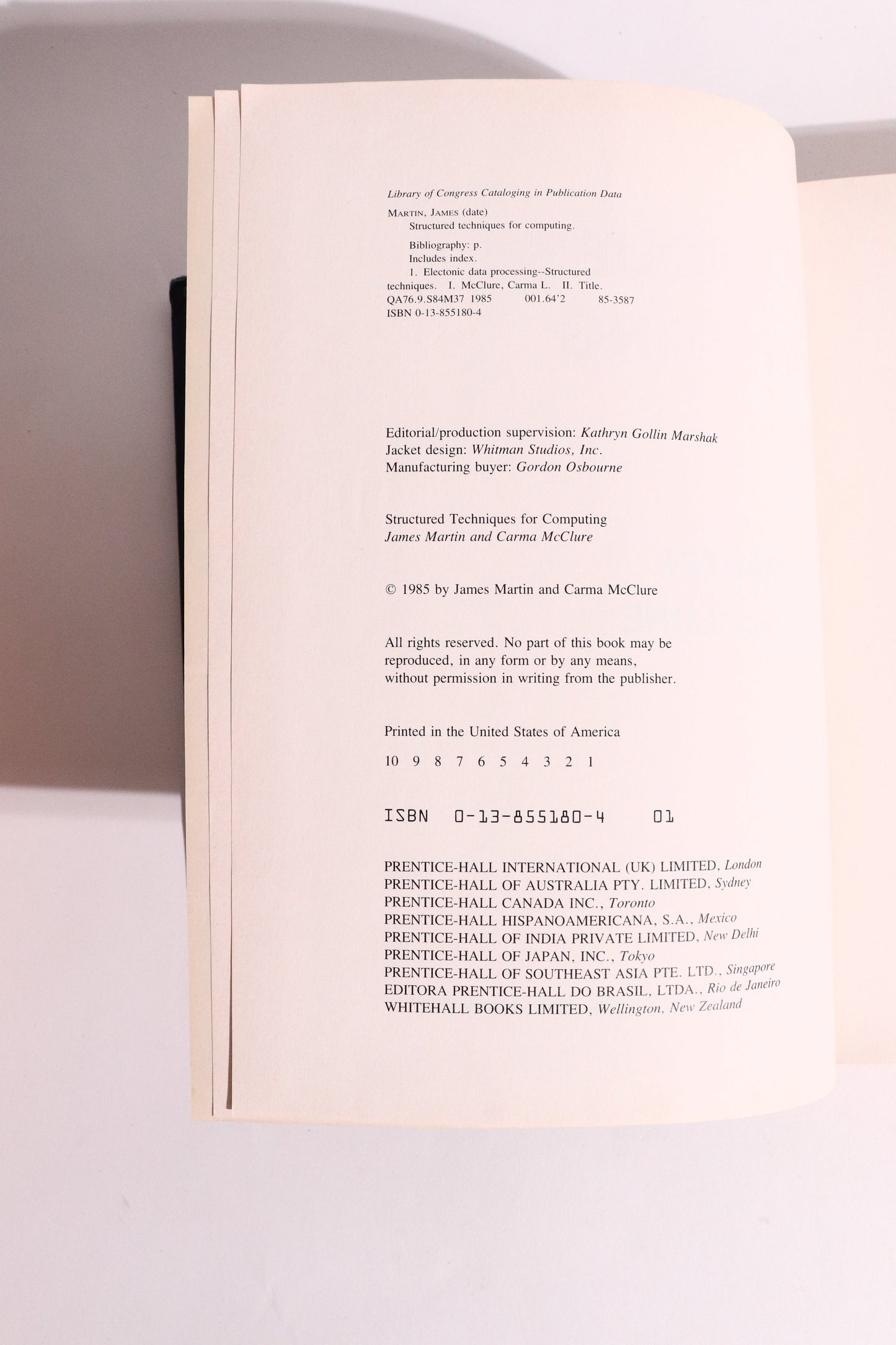
Pages: 775
Format: Hardcover
ISBN-10: 0-13-855180-4
ISBN-13: 978-0-13-855180-3
LCCN: 85-3587
Condition: Vintage ex-library hardcover in dark blue boards. Former institutional copy with spine call-number label/tape and other typical library markings. Boards show light shelf wear, rubbing, and minor corner/spine wear. No dust jacket present. Interior appears clean and firmly bound overall with normal age-related wear. See photos for exact condition.
Shipping
Shipping
USA DOMESTIC SHIPPING
We offer standard shipping (5–9 business days) on all U.S. orders.
CANADIAN SHIPPING
Orders within Canada typically arrive within 3–7 business days. Please note that depending on the product or supplier, customs or duties may apply.
INTERNATIONAL SHIPPING
We offer standard international shipping (2–6 weeks). Import duties, taxes, and charges are not included in the item price or shipping cost. These charges are the buyer's responsibility and may vary by country.
Hassle-Free Returns
Hassle-Free Returns
We hope you love what you ordered! If something isn’t quite right, whether it’s the size, color, or simply not what you expected, feel free to reach out.
Returns and exchanges are handled according to our policy, which may vary depending on the product. You can review all the details here.
If you have any concerns or would like to discuss an exchange, don’t hesitate to contact us, we’re happy to help.
Our goal is complete customer satisfaction.



Shop with Purpose
OSADIA is a Spanish word that means "audacity." We believe this word reflects the unique journey and stories behind our products, those stories are all about hard work, courage and resilience. In Osadía you will find unique fair trade, handmade & socially responsible products, every product is empowering artisans, small businesses and vulnerable communities around the world.